
Play Now
Join a Game
Characters
Shop
Tools
Compendium
Community

Sign In

Play Now
Join a Game
Characters
Shop
Tools
Compendium
Community
Sign In
The Western Frontier is more than just a collection of towns. It is tied together by stories and deeds, by the heroes people celebrate, and the villains they fear. These people loom larger than the places in which they live. It doesn’t matter if you’ve ever been to Ardev, if you’re on the frontier you’ve heard of Count ir’Blis. And though you may never go to Turakbar’s Fist, you’ve certainly heard settlers cursing Rhesh Turakbar and seen people repairing the damage caused by his raids. This section provides the publicly known facts about these people, along with rumors that are circulating about them. It’s up to you what your character has heard or believes—and up to your DM to decide which (if any) of these rumors are true!
“The silent man has no one to blame but himself.” Anyone born in Breland knows the proverbs of Beggar Dane, whose collected wisdom celebrates the pragmatic spirit of the nation. Dane is an apocryphal figure; some say he was a bard who wandered the streets of Sharn, while others insist that he advised Galifar I himself during the war of unification. Whatever the truth may be, Beggar Dane is a beloved Brelish everyman, and his wisdom is celebrated in Brelish taverns and homes every day. But now, in 998 YK, there is a new Beggar Dane; an anonymous figure who speaks on behalf of the Swords of Liberty, a widespread network of insurgents who rail against the Brelish monarchy. Some believe that this Beggar Dane is a fictional figurehead, a mask that can be used by any cell leader. But the Sharn Inquisitive has done a deep investigation into the Swords of Liberty, and they are convinced that Beggar Dane is one person—a mastermind who is coordinating the actions of the western Swords cells. The Inquisitive further believes that Beggar Dane is driving the increasingly violent actions of the Swords.
The Swords of Liberty began as a peaceful political movement, calling for King Boranel to voluntarily cede power to the Brelish parliament. In 996 YK, a statement from Beggar Dane took credit for an attack on Castle Arakhain that left the east wing of the Winter Palace in flames. Over the last two years, the Swords of Liberty have struck at nobles across Breland, stating that there will be no peace until the aristocracy is dissolved. According to Beggar Dane, even that victory wouldn’t mean the end of violence. Beggar Dane accuses King Boranel of betraying the Brelish people both by accepting the terms of the Treaty of Thronehold and providing shelter for Cyran refugees. Dane maintains that Breland could have easily won the Last War if its leaders had truly wished to do so; in certain tracts, he suggests that there is a conspiracy among all the Wyrnarn monarchs, that Boranel has intentionally misled his nation to benefit his royal cousins. He promises that once the monarchy is overthrown, the new army of the common people will bring unity to all of Khorvaire—and that they will deal with both the “monsters to the west” (Droaam) and the “enemy we have welcomed in” (Cyrans).
Beggar Dane’s identity is a closely guarded secret. He’s mainly known through the proclamations that supporters share in villages and farms. However, a masked figure claiming to be Beggar Dane has spoken at rallies and been seen during Swords attacks. According to these reports, he’s a male human or half-elf; as he’s masked and shielded against divination, little else is known. Beggar Dane is believed to be on the Western Frontier and there are many in the west who support his actions, even if they aren’t willing to take up arms for his cause. Whether or not you’ve ever seen Beggar Dane, if you have been on the frontier for long, you’ve certainly heard of him.
While there are some similarities between Beggar Dane and the Company of the Black Crown, the two are actually very different. The Black Crown are a force of brigands; they may avoid the law, but they don’t hide who they are or what they’re doing. By contrast, the Swords of Liberty are covert insurgents whose members are hidden in communities across Breland. The Black Crowns defy Brelish law, but they’re interested in lining their pockets, not in driving political change; the Swords of Liberty are only interested in change, and every violent action they take advances that agenda.
The Sayings of Beggar Dane
The proverbs of Beggar Dane are well known throughout Breland. The Sharn Inquisitive often posts one of Dane’s sayings with editorial comments on how they apply to the present day. Here’s a few examples, but there are hundreds of these sayings, covering politics, religion, and everyday life; if your character is Brelish, feel free to come up with
new proverbs:
In a region where bandits are as common as copper pieces, the Company of the Black Crown have earned their infamy. The core of the company were members of an elite unit of Brelish soldiers stationed at Orcbone. Their captain, Breggan, regularly ignored her orders and waged her own personal guerrilla war against Droaam, slaughtering goblin villages and leaving gruesome displays that could chill even a medusa’s blood. Some stories say that Breggan sought to avenge the slaughter of her own family at the hands of monstrous raiders. Others suggest that she admired the ferocity of her foes, that in seeking to match their cruelty she became a monster herself. One especially dramatic tale says that after losing an eye in a battle with a minotaur champion, she plucked out the eye of her fallen foe and pressed it into her own socket, so she could see the world as her enemies do. When she was finally called to account for her cruelty and violation of orders two years ago, she broke with Breland, and many of her soldiers followed her. Now she claims that she is a true daughter of Breggor Firstking, the founder of the ancient nation of Wroat, and that a vision from her ancestor guided her to find his black iron crown. She says that Boranel betrayed his people by failing to bring Droaam to heel, and that she is the champion of the abandoned people of the Western Frontier; she calls herself “the Queen of the Lost,” subject to the laws of no nation.
Breggan Blackcrown is a human woman in her thirties, equally skilled with sword and wand. She’s more than just a wandslinger; stories suggest she could be some sort of warlock. She’s as charming as she is ruthless, and never underestimates a foe. Her success to date is no accident; Breggan is a brilliant leader and her soldiers are exceptionally loyal to her, willing to take any risk in her service. Her primary lieutenants are Dusker (female gnome, scout and assassin), her bodyguard, Blessing (nonbinary warforged, a heavily armored defensive fighter), and Sigil (male human, the war mage who maintains the company’s artillery).
The Company of the Black Crown is a mobile force trained in the techniques of guerilla warfare. They have a few Long Rods and other military-grade weapons. They ride the very edge of Droaam and Breland, defying both nations and preying on the people of both lands. They frequently target other brigands and clash with Droaamite raiders, and most believe that this is why the commander of Orcbone chooses to ignore them; others say that the commander is one of Breggan’s former lovers, or that he doesn’t want to send his soldiers to their deaths. Regardless, for now Orcbone isn’t pursuing the Black Crowns.
While the Black Crowns ruthlessly slaughter other brigands and raiders, they’re no angels. They rob small villages and caravans—never taking all the spoils, just “collecting the Crown’s share.” While they usually don’t kill villagers, they make a bloody example of anyone who challenges them.
The Brelish are practical people, with little time for the esoteric mysteries and enigmatic traditions of the fey. Where the people of Aundair entertain hosts of superstitions and have long made deals with the fey, the Brelish prefer to avoid the fey, ignoring their signs and avoiding their domains. Briar, a young, nonbinary elf and Greensinger druid, has come south from the Eldeen Reaches to serve as a guide and an ambassador between these two worlds. They travel across the frontier, visiting towns and villages. First and foremost, they are an entertainer—always finding reason to delight people with a story or a song. Briar is always equally keen to hear a new story—for stories are the maps of the fey, and it is by learning the local stories that Briar can identify the fey who have influence in a region. Briar does their best to help people, both by mediating any disputes between settlers and the fey (disputes the settlers may not even be aware of), and by doing favors for both archfey and the mortal inhabitants of the region. They say that their sole motivation is to be a part of the stories that are unfolding in the region, and to ensure that they end well. Some don’t trust Briar, suspecting that the elf is engaging in mischief on behalf of the fey. But most settlers are happy to see the Greensinger, and village children are sure to demand a story from Briar.
As a Greensinger druid, Briar is an accomplished shapeshifter; any animal you encounter on the frontier could potentially be Briar. They’re usually happy to offer advice or to help resolve trouble with the fey, but they may require a story or a favor as payment for their services—and such favors can potentially lead to unusual adventures.
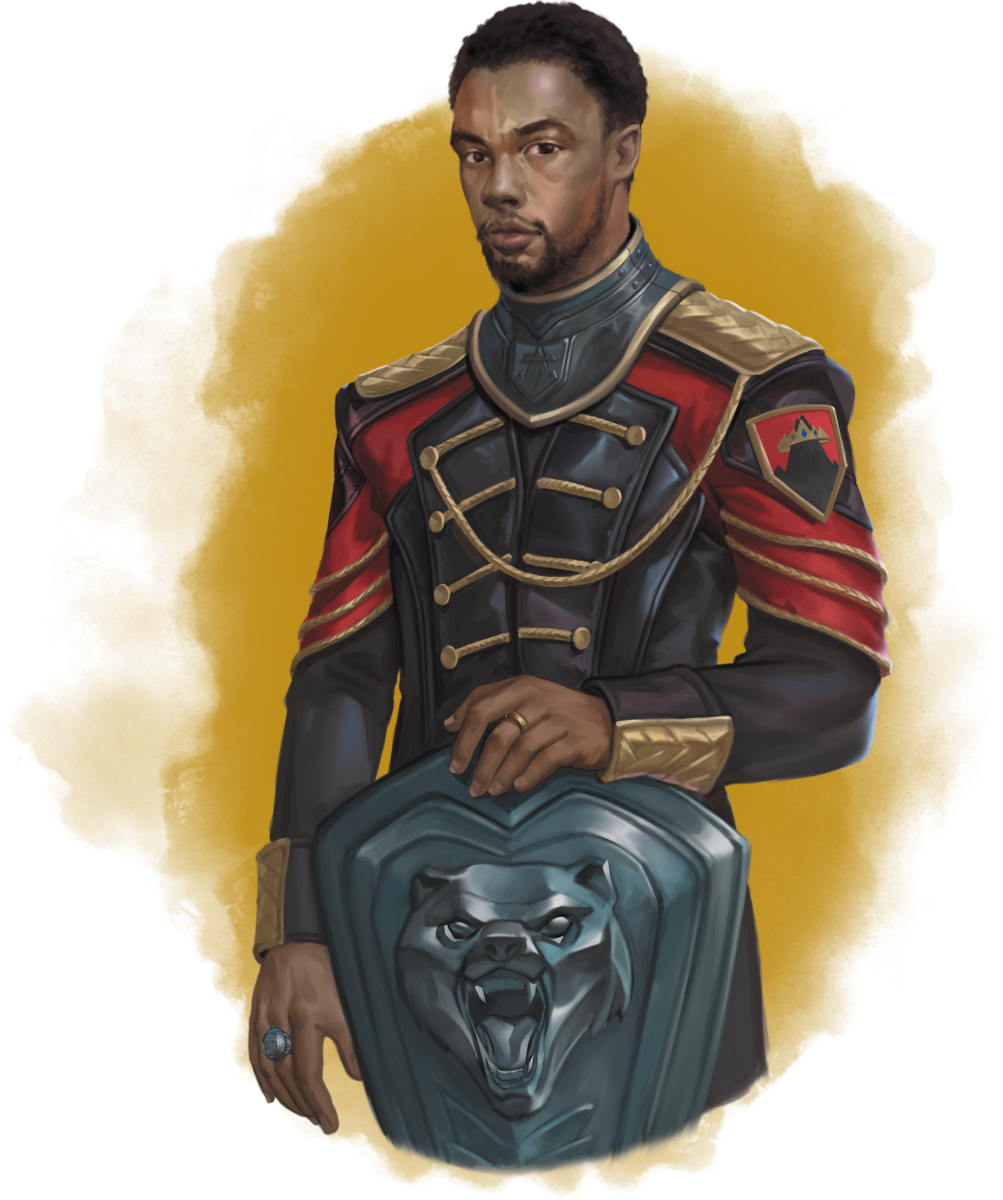 Ardev is the ancestral seat of the ir’Blis line. Thavius ir’Blis is the ruling count of the Western Frontier, formally styled as the Shield of the Graywall in recognition of his responsibility over this border region. In his youth, Thavius led troops on the northern front. Then came the Daughters of Sora Kell. In 986 YK, Countess Thalia ir’Blis (the mother of Thavius) personally led the Westwind Riders to deal with the forces that had claimed the town of Stubborn (now known as Stonejaw). The countess and all of her troops were killed, and the Daughters retaliated with a devastating attack on Orcbone. Thavius was called back to Ardev, both to assume the position of Count and to defend the west against this new threat. He didn’t stand alone; King Boranel sent troops to reinforce this new front line. While these forces were necessary to defend the border against the unexpected power of Droaam, they were servants of the king, not the count. Thavius served with distinction both on the field of battle and as a commander, but he could only control the forces under his command and chafed at the poor decisions of the eastern soldiers. Breggan Blackcrown is a key example of this: The bandit queen originally served under Lord Veirner ir’Tajar of Orcbone, and Thavius holds ir’Tajar responsible both for Breggan’s conduct during the war and her current brigandry. With the current de-escalation of hostilities, most of the royal forces have been withdrawn; but Lord Veirner has been retained as the Viscount of Orcbone, and Argonth has been assigned to the region.
The ir’Blis line has governed this region since Galifar was founded. It has always been a vast and largely empty county; even before Droaam, the Barrens to the west were a dangerous, unclaimed land. The rise of Droaam as a nation has been a tremendous blow to the ir’Blis family. While it was largely undeveloped, they saw the Western Frontier as their domain. Now that land has been claimed by a new and powerful nation. Orcbone has been stripped from the domain and granted to an eastern noble—and aside from his wounded pride, the count despises ir’Tajar. Quickstone has gone from being a backwater smuggler’s haven to a boom town drawing in the dragonmarked houses. Count ir’Blis wants to do what’s best for his people, but he is still trying to determine what that even is. He yearns for vengeance against Droaam and the Daughters of Sora Kell, but he recognizes that his people need peace—and that there’s no telling how a true war with Droaam would end.
At the end of the day, Count Thavius ir’Blis is quintessentially Brelish. He is proud, but his pragmatism comes first. He upholds the law, but is willing to overlook the work of an honest smuggler; he knew what he was doing when he allowed the Three Faces of Coin to have a foothold in Quickstone. He showed charity to Cyran refugees, but he also placed them on the border with Droaam—setting them between his own people and an unknown threat. Keep this in mind when dealing with the count: He is a soldier who has commanded troops in battle. He takes his station seriously. But above all, he is a practical man who does what’s best for his people and his family.
Count ir’Blis is largely respected by the people of the frontier. He is seen as a just man, from a family that’s never been too heavy handed. But the people of the frontier are an independent lot. The Swords of Liberty are strong in this region; even if its members don’t see the count as a villain, he is still a brick in a wall they’re going to tear down. Some are angry that the count isn’t leading an army against Droaam; others are afraid that he can’t protect them from the nation of monsters. And they may be right.
 The Daughters of Sora Kell are a shadow that hangs over the Western Frontier. They’re more than just the rulers of a nation; they are legends. If you grew up on the Western Frontier, you grew up hearing stories about the Daughters—how Sora Maenya consumes children who stray from the path, how Sora Katra knows every time a lie is told. . . and how she may come in the dark to steal the teeth or eat the fingers of those who lie. You know how Sora Maenya killed a dragon with her bare hands and then ate the whole thing. The Daughters of Sora Kell aren’t just monsters; they are the monsters you were taught to fear as a child, the monsters you believed were lurking in the shadows outside your window and the darkness below your bed. And now those monsters live next door and have an army of armored ogres and bloodthirsty trolls. It’s an idea that takes some getting used to. Some superstitious settlers refuse to mention Sora Teraza by name, believing that it draws her attention; if they must discuss her for some reason, they call her “the blind queen.” A few take this further, referring to Sora Maenya as “the mighty queen” and Sora Katra as “the beautiful queen.”
If you’re from Droaam, you have a different relationship with the Daughters. “Sora’’ is the Goblin word for “grandmother,” and many Droaamites—especially the goblins and kobolds of the Barrens—have come to think of the Daughters as part of their families. They’re the mothers of the nation. Yes, they demand respect, and yes, they may tear you apart and eat you if you step out of line, but that’s why you should respect your grandmother! Droaamites take pride in the fact that their grandmothers terrify the people of the east. Having said that, this does depend on where you’re from. The medusas of Cazhaak Draal and the tieflings of the Venomous Demesne largely see themselves as equal partners in the Droaam experiment; they respect the Daughters, but don’t idolize them. And there are certainly a handful of former chibs who despise the hags, or dream of unseating them and stealing their crowns.
More detailed information about the Daughters of Sora Kell and their servants can be found in chapter 4 and in Exploring Eberron.
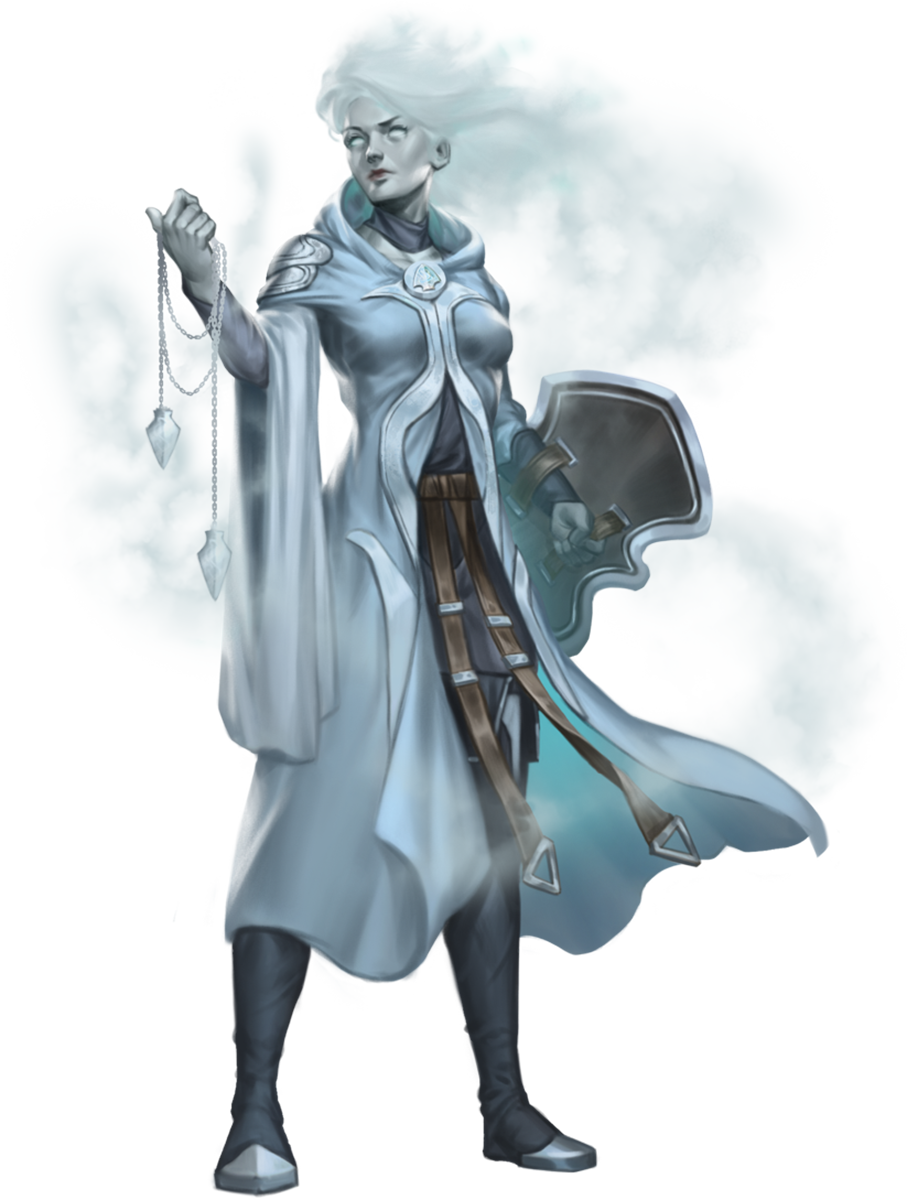 Droaamites have little love for the Church of the Silver Flame. The mission of the Church is to protect the innocent from supernatural evil, and throughout most of its history, the church has categorized many of the denizens of Droaam as supernatural evil. When templars have come to the frontier, they’ve usually been crusaders, driving “monsters” away from the lands of humans and their kin. Many—especially the extremist followers of the Pure Flame—still hold to these beliefs. But with the rise of Droaam as a nation, there are some in Thrane who believe that the Church needs to reevaluate this stance, to see if the denizens of Droaam are just as innocent as humanity.
Epitaph is a tiefling, touched by the power of Dolurrh. She has gray skin and pale eyes. Mist trails from her skin and hair, and those touched by these mists may hear the whispers of the dead. Epitaph was driven from her village as a child, and was raised in Rellekor—a sanctuary for tieflings established by the Church of the Silver Flame. This is part of what drives her; her kind were once considered monsters, but today she’s a servant of the Flame. She seeks to heal the wounds inflicted by past crusades and understand the people of Droaam. With that said, Epitaph knows that there is evil on the frontier. She believes that ogres and kobolds may be able to find a path to the Flame, but the Cults of the Dragon Below and the servants of the Horned King threaten everyone. Epitaph travels across the frontier, offering aid to those in need and searching for these greater evils. She has the base abilities of a Priest (with the added traits of a Dolurrhi Tiefling); while significant, she can’t overcome the greatest threats of the frontier on her own. She may offer assistance to adventurers she encounters, or ask for assistance with threats she’s uncovered. It’s up to the DM to decide if Epitaph has managed to win allies among the Droaamites, or if she is despised by them.
Kethelrax the Cunning, a red-scaled kobold, is the warlord of Shaarat Kol. Sometimes called the Goblin Prince, Kethelrax has been a rallying figure for people who have been oppressed throughout the history of the region. Kethelrax was born into one of the Khaar’paal kobold clans of the Graywall Mountains. Gifted with sorcerous power, these kobolds have largely remained in their fortified tunnels, ignoring both the humans to the east and the raiders to the west. Young Kethelrax was curious and keen to explore the western lands—but soon after he ventured into the Barrens, he was taken prisoner by an ogre chib who dominated a village of kobolds and goblins. Kethelrax served this ogre for a time, learning the ways of the Barrens and his oppressed cousins. Before the Daughters exerted their influence over the land, the Barrens were violent and unstable; the ogre chib was in turn slain by minotaur raiders, who took Kethelrax and some of the others back with them to the fortress that was then known as Haalrac’s Fist. Kethelrax had many opportunities to escape; he’d been honing his sorcerous talents throughout his time in the western lands, and his captors had no idea of what he was capable of. But Kethelrax wasn’t content to escape alone. As a servant, he managed to manipulate the warrior Turakbar, playing on the minotaur’s ego. Kethelrax convinced Turakbar to slaughter the reigning clan lord, Haalrac, and in the ensuing chaos, the kobold was able to free a host of goblins, kobolds, and others forced into service in Haalrac’s Fist. Kethelrax led this band south, hoping he could convince the Khaar’paal to take in these refugees. But during the long journey, Kethelrax was visited by a blind hag who urged him to take shelter in some Dhakaani ruins in the foothills of the Graywall Mountains. Sora Teraza told Kethelrax that change was coming to the Barrens—and that there was a need for a leader who could inspire the small folk of the Barrens, rallying goblins and kobolds alike. Over the next few years, Kethelrax and his band targeted weak chibs in the region, freeing their prisoners and building a significant force. It wasn’t easy, and Kethelrax suffered a number of bloody defeats—but he and his people remained strong. In 985 YK, Sora Katra came to Kethelrax. She explained the Daughter’s vision for the region, and made a bargain with Kethelrax: If he could seize the fortress now known as Shaarat Kol, he could hold it as a warlord of Droaam, creating a haven for goblins and kobolds. Kethelrax agreed, and over a decade later he still reigns as the Goblin Prince of Shaarat Kol.
Kethelrax the Cunning lives up to his epithet. He is both clever and charismatic, able to inspire his people but equally adept at deceiving his enemies. His primary motive is always to improve the lives of the kobolds and goblins of the western plains, and this has led him to be one of the most trusted allies of the Daughters of Sora Kell. While some warlords chafe at the Daughters’ rule and yearn for greater power, Kethelrax recognizes that a strong and united Droaam holds many opportunities for his people. He continues to improve Shaarat Kol, working to make it a haven for both smugglers and honest traders. With that said, he still has a number of old scores he’d like to settle with those chibs and warlords that have long oppressed the small folk. He has so far been unable to convince the Khaar’paal kobolds to ally with the Daughters, but he continues to work to win them over.
Kethelrax is a charismatic speaker who possesses both arcane gifts and a knack for knives. He’s known for his ability to conjure blades of flame (something that mimics both Flame Blade and Fire Bolt, as he can fling his fiery daggers). He prefers to outwit enemies rather than to rely on force to solve his problems… but he’s deadly when he needs to be.
Rhesh is a minotaur title. Generally translated as “clan leader,” it more literally means “blessed warlord”—the chosen of the Horned King. Turakbar claimed the title by butchering his predecessor, Rhesh Haalrac, and seizing control of the Kor’mur clan and the fortress known as the Fist—now, Turakbar’s Fist. The Kor’mur (“Blood Horns”) interpretation of the Horned King is a tyrant who rules through bloodsoaked intimidation, and Turakbar follows this example. He revels in his role as a champion of dark powers. His horns and armor are engraved with glowing runes, and he enjoys crushing the life from his foes with his massive clawed gauntlet. But those who have met him can attest to the fact that he’s more than just a bloodsoaked brute. Turakbar is surprisingly clever, and has a talent—a gift of the Horned King—for sensing the fears of others. He enjoys tormenting his foes and rivals, both physically and psychologically. While he’s not the most powerful of the warlords of Droaam, Rhesh Turakbar may well be the most monstrous.
The Kor’mur are the largest of the minotaur clans, and the Fist is a powerful fortress on the edge of Breland. Both led the Daughters of Sora Kell to appoint Turakbar as the warlord of the region, further establishing his dominance over the other clans. When the hostilities between Breland and Droaam were at their height, Rhesh Turakbar raided deep into Brelish territory, sowing terror and burning supplies. Today, Turakbar and his forces primarily patrol the border between Droaam and Breland, but they also regularly raid into Brelish territory. They generally remain north of Graywall, avoiding the main trade road—but anything else is fair game. They rarely actually take anything in their raids, and they often wound or maim victims rather than killing them; their goal is fear, not plunder. The Daughters of Sora Kell claim that these raids are the fault of Breland for refusing to recognize Droaam and thus allowing for an absolute determination of borders; they say the violence is Breland’s fault, both for settling too far west and for refusing to include Droaam in the Treaty of Thronehold.
If your character is from the Western Frontier, it’s entirely possible you’ve already had an encounter with Rhesh Turakbar. His reavers could have razed your farmstead or killed your friends or family, leaving you alive and hungry for revenge. Perhaps it seemed as if he was going to kill you, and then he turned aside—and you’ve always wondered why.
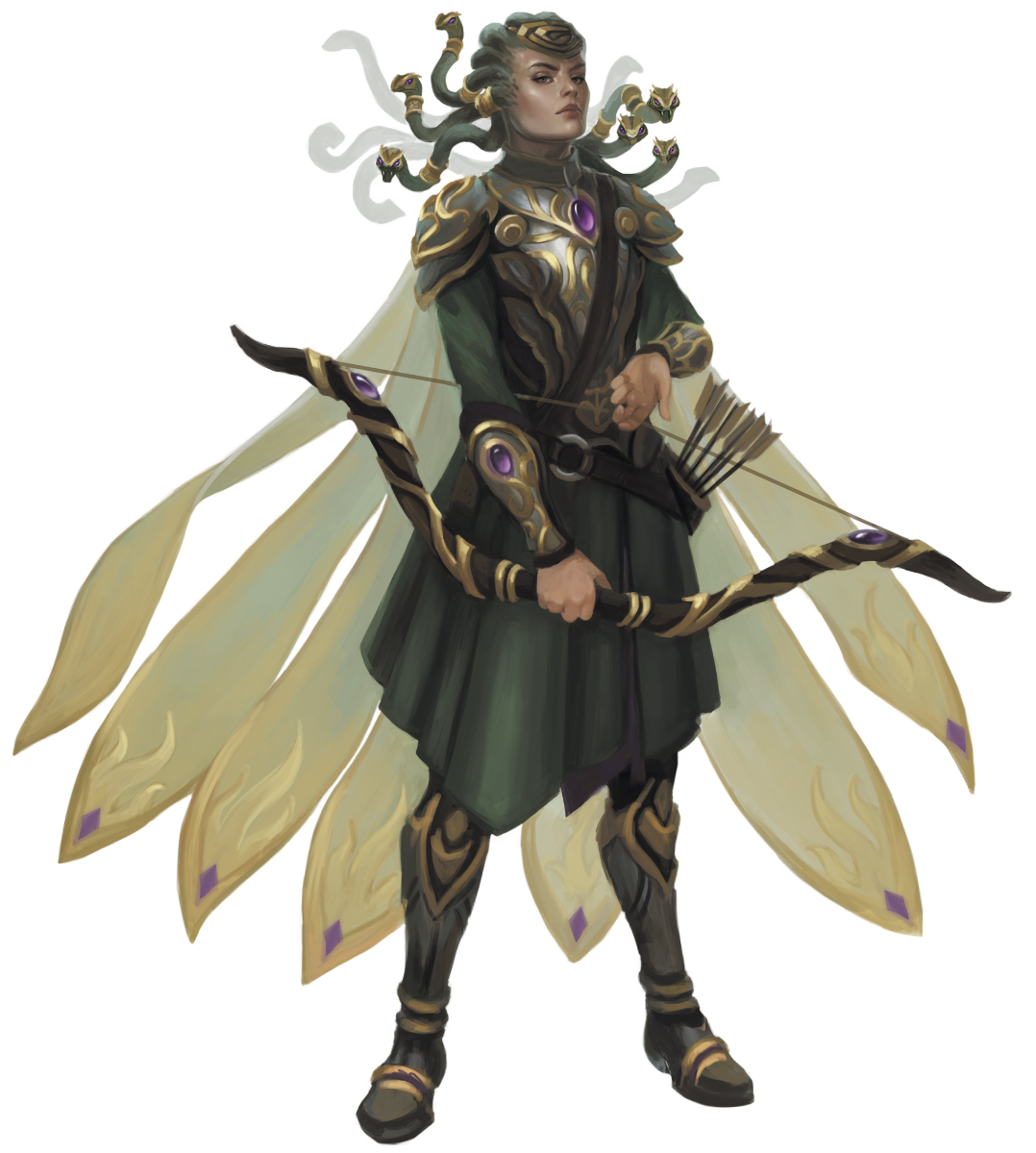 The medusas of Cazhaak Draal are among the most feared denizens of Droaam, and their leader, Sheshka, is a sinister legend. The Queen of Stone is a deadly warrior and brilliant general; over the last decade she led troops into battle on the Brelish front, and also helped the Daughters crush those who opposed their vision of a united Droaam. Cazhaak Draal is an integral part of that dream; the most powerful priests of the Dark Six are medusas, and medusa architects direct the construction of the booming cities of Droaam. Many of the magistrates and envoys of Katra’s Voice are medusas. Sheshka knows all this. She works with the Daughters not because she fears their power, but because she truly believes that Droaam could become something great. But while she may be driven by idealism, she is a cold-blooded pragmatist who can be every bit as ruthless as Sora Katra in pursuit of her goals.
While Sheshka holds the title of queen, her power is ultimately spiritual. The medusas believe that she is beloved by the Shadow, and she has the support of both her people and the priests that guide them. She is the proud queen of a proud people, and she believes in their shared destiny. While this could just be hyperbole, stories say that the Queen of Stone has powers far greater than the typical medusa. It’s said that she can speak to petrified creatures or restore their flesh, and that when Sheshka petrifies a creature, only she can end the curse.
Sheshka is literally cold-blooded. Should you ever cross her path, it is unwise to rely on her compassion. But all accounts suggest that she rules with integrity and intelligence—that she will always consider a well-reasoned argument, and that should she give her word she will stand by it. Even beyond the medusas, there are many who say that of all the warlords of Droaam, it is Sheshka alone who truly feels like a queen. Keep these things in mind when you meet a medusa. They may be terrifying monsters, but they are also the proud citizens of an ancient city-state.
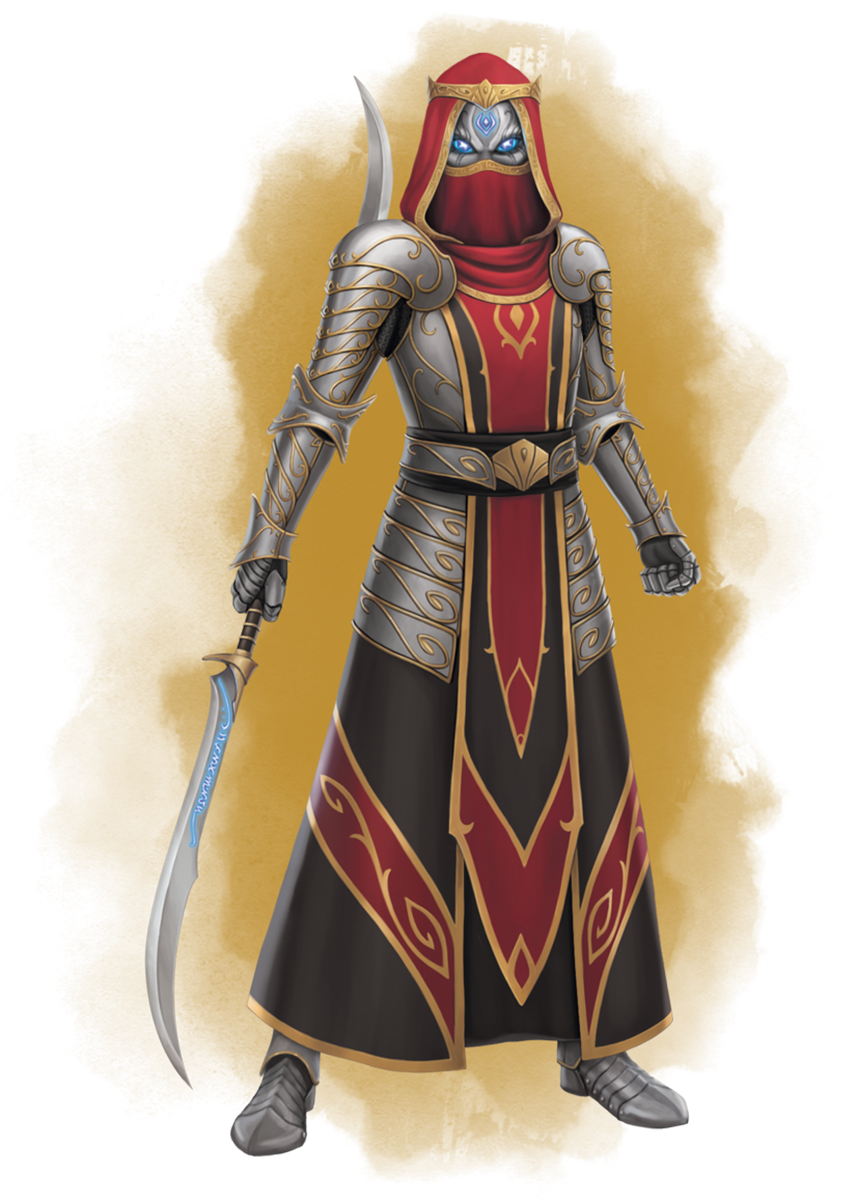 While the frontier has more than its fair share of villains, there are at least a few heroes out there aside from your adventurers—a handful of champions celebrated in song and story. Vael is just such a figure, a masked hero who protects common folk from reavers and brigands. They’re armed and armored in the fashion of the elves of Valenar, wielding a double-bladed scimitar with deadly skill. But Vael is no mercenary and accepts no payment from the people they aid. When asked why they’re so far from their homeland or why they place themselves in danger to help strangers, Vael invariably responds “I do what must be done.” Some believe Vael has a definite purpose—that they are searching for a rival, or waiting for an event that could be years in the future. Those more familiar with the Tairnadal say that Vael is likely following in the footsteps of their patron ancestors, that they may be emulating the deeds of an ancient champion of the common people. However, Vael will not speak of their ancestor, and while their armor has the traditional Tairnadal trappings that should identify a patron ancestor, no scholar on the frontier has ever been able to identify Vael’s patron.
Vael never removes their armor or mask, and they will not speak of their own past. They seem to benefit from some form of enchantment that sustains them without the need for food or drink, though they will often sit in the common room of a tavern to enjoy the scents or the music. As an elf, they do not sleep; even in their trance, they always remain on guard.
If you’re a Tairnadal elf, it’s possible you know Vael. It’s also possible that you encountered the elf on the battlefields of the Last War, or that they assisted you at some point in your past; if you want to explore one of these ideas, discuss it with the DM. Otherwise, you can always hope that if you find yourself outnumbered or outmatched by your enemies, this masked stranger will come to your aid.